



|
Celebrate More Talent 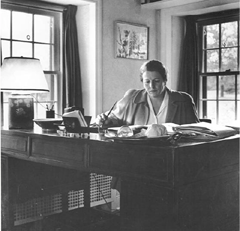 William Penn (1644-1718)
This statesman, diplomat and founder of Pennsylvania made his home at Pennsbury Manor on the Delaware River in Bucks County, one of his original Quaker Commonwealth Counties. There he fostered religious liberty in what he called his "holy experiment." In his document, "The Frame of Government," he provided for complete religious liberty within the framework of a workable constitution. The Manor House, its grounds and buildings are open to visitors.Edward Hicks (1780-1849)
A Quaker minister, Hicks supported his preaching, teaching and travel throughout the early Colonies on painting, selling numerous versions of his vision of the Garden of Eden - The Peaceable Kingdom. These paintings, among the most famous of American primitives, depict Hicks' hopes for America. Major museums around the country, including the James A. Michener Art Museum in Bucks County, own original works of The Peaceable Kingdom.Henry Chapman Mercer (1856-1930)
A true Renaissance man, Mercer was an author, architect, scholar, artist, archaeologist, antiquarian and anthropologist. He collected enough tools, furniture, folk art and implements of early America to fill over one million cubic feet of the museum he designed and constructed out of hand-poured concrete. He also built Fonthill, his 44-room home dubbed "a concrete castle for the New World." The decorative tiles he made at his Moravian Pottery and Tile Works placed him at the forefront of the Arts and Crafts movement. All three buildings are located in Doylestown, Bucks County and are open to visitors.Saint Katharine Drexel (1858-1955)
Katharine Drexel walked among the Native and African American peoples of her time and heard their cry for justice, their hope for unity and their dream of peace. A wealthy, educated Philadelphia socialite, Katharine chose to commit her entire life to bringing the news of Christ to these oppressed peoples. After founding the Sisters of the Blessed Sacrament in Bensalem in 1891, she and her Sisters established schools and catechetical and social centers on reservations in the rural South and in large urban areas. Today, Katharine's vision lives on in the work of the Sisters, reaching as far as Haiti, the western hemisphere's poorest country. Katharine Drexel was canonized on October 1, 2000 in Rome.
Taken from the Sisters of the Blessed SacramentPearl S. Buck (1892-1973)
The first American woman to win the Nobel Prize for literature, Buck spent four decades on her 60-acre Bucks County homestead, Green Hills Farm. There, at her handcrafted Chinese hardwood desk, she penned her Pulitzer Prize winning novel The Good Earth. But this multi-faceted woman, an author of over 40 works of fiction and non-fiction, was also a humanitarian, teacher, civil-rights pioneer and mother of eight children. Her humanitarian efforts continue through the Pearl S. Buck Foundation, which provides aid to neglected children and oversees adoption services. Her house and grounds are open to the public.Jean Toomer (1894-1967)
Jean Toomer was a leading literary figure driving the Harlem Renaissance, the 1920's flowering of African-American culture in New York. His best-known work, Cane, is universally recognized as a classic for its lyrical portrayal of the daily experiences of rural blacks, as well as its inventive weaving of poems and short stories. Toomer's later works were filled with an idealistic vision of a mankind free of racial barriers.Oscar Hammerstein, II (1895-1960)
For the last 20 years of his life, lyricist Oscar Hammerstein lived in Bucks County, and with composer Richard Rodgers, created some of the most influential and sophisticated musicals for the American stage. Beginning with Oklahoma! in 1943, which won a special Pulitzer Prize, and concluding with The Sound of Music in 1959, Rodgers and Hammerstein collaborated on such classics as The King and I, Flower Drum Song and South Pacific, based on the James A. Michener story.Ben Solowey (1900-1978)
Painter and sculptor Ben Solowey found his subjects in such diverse scenes as the landscape outside his Bucks County studio door, his wife Rae at their farmhouse window and the backstages of Broadway in its heyday between 1929 and 1942. The New York Times and the Herald Tribune commissioned his theater portraits. As a court artist to Broadway royalty, he defined an era with his striking charcoal portraits of such luminaries as Katherine Hepburn, Ethel Barrymore, Lawrence Olivier and Marlene Dietrich. His studio is one of the last of the Bucks County artists' studios still open to the public.George Nakashima (1905-1990)
Artist George Nakashima became world renowned for his handcrafted walnut and redwood furniture. Working from his studio in New Hope, Bucks County, he designed and built the exquisite furniture that attracted an international clientele. A major retrospective of his work was held at the American Craft Museum in New York in 1989. Today, his daughter Mira Nakashima continues her father's work in the same studio where his devotion to "nature's art" first took form. The studio, a small museum and the grounds are open to visitors.James A. Michener (1907-1997)
Michener was awarded a Pulitzer Prize for Tales of the South Pacific, the basis for the Rodgers and Hammerstein musical South Pacific. He roamed the world, gathering material for bestsellers like Sayonara and Hawaii. Although his books depict exotic places and people, James Michener's ties to Bucks County are strong and enduring. He endowed Bucks County with the James A. Michener Art Museum, in his birthplace, Doylestown. One of the finest small art museums in the country, it houses a special collection that reflects the depth and diversity of Bucks County art.Stan & Jan Berenstain
From their home in Bucks County, this husband and wife team create friendly, loveable characters, the Berenstain Bears, known to millions of children. Their bear family books have sold over 180 million copies. Television specials, videotapes and over 150 licensed products have expanded their popularity.Robert & Joyce Byers
Ask anyone about Byer's Choice and the first thing that comes to mind are the delightful and original Carolers® figurines Joyce Byers has been producing for more than twenty years. But just as unique are the philanthropic efforts of the Byers Foundation, an organization run by Joyce's husband Bob Byers that has touched the lives of many. The philosophy of the Byers Foundation is one of responsibility to the community - to give back, improve the lives of others and make our world a better place to live. Since its inception in 1986, the Byers Foundation has each year donated one million dollars to more than 350 organizations.
|

